Easy Home Workout Plan Without Equipment — Step-by-Step for Beginners
: No gym? No problem. This step-by-step home workout plan uses zero equipment and builds real strength in 4 weeks. Perfect for beginners — start today in 20 minutes
You can build real strength, improve endurance, and burn fat at home with zero equipment. All you need is your body, a small floor space, and a structured plan. This guide gives you a complete 4-week beginner workout program — no gym, no gear, no excuses
Does Bodyweight Training Actually Work?
If you’ve been told you need a gym to get fit, you’ve been misled.
The American College of Sports Medicine (ACSM) — the world’s largest exercise science organization — recently updated its training guidelines for the first time in 17 years. After reviewing data from over 30,000 participants, researchers concluded that non-traditional training including bodyweight exercises and home-based routines, can build strength, promote muscle growth, and improve physical function.
Harvard Medical School agrees. Body-weight exercises are considered more functional than machine-based training because they work multiple muscles and joints simultaneously, engage balance, and mimic everyday movements.
And perhaps the most encouraging finding of all: in a study of active adults in their 60s, researchers found that a simple lower-body bodyweight routine increased muscle strength and power by about 15% after 10 months — achieved with only six workouts per month.
Six workouts a month. That’s less than two per week.
Research over the past decade confirms that bodyweight training can build muscle and strength comparable to traditional weightlifting — when intensity is sufficient. The key phrase there is when intensity is sufficient, which this plan is designed to deliver.
The bottom line: your body is all the equipment you need. Let’s use it.
What You Need Before You Start {#what-you-need}
One of the best things about this plan is how little setup it requires:
- Space: A 6×6 foot area of floor space — a bedroom, living room, or balcony works fine
- Surface: A yoga mat is helpful but not required; carpet or a folded towel works
- Clothing: Anything comfortable you can move in
- Time: 20–30 minutes, 3 days per week
- Equipment: None
That’s it. No dumbbells, no pull-up bars, no resistance bands. Just you.
The Essential Bodyweight Exercises
Before jumping into the plan, get familiar with these foundational movements. Good form prevents injury and makes every rep count more.
🔵 Lower Body
Bodyweight Squat Stand with feet shoulder-width apart, toes slightly turned out. Lower your hips back and down as if sitting into a chair — keep your chest tall, knees tracking over your toes, and heels firmly planted. Drive through your heels to stand. Muscles: Quads, glutes, hamstrings, core
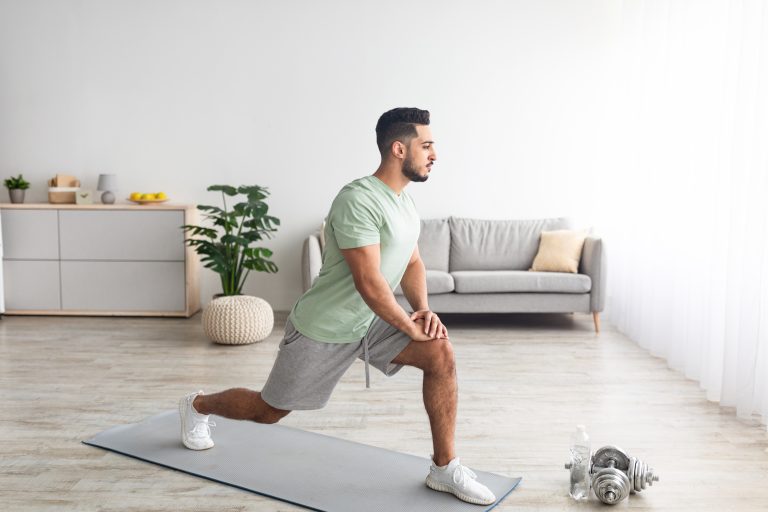
Reverse Lunge Stand tall, step one foot backward, and lower your back knee toward the floor. Keep your front shin vertical — your knee should not push past your toes. Push off your front foot to return. Muscles: Quads, glutes, hamstrings, balance
Glute Bridge Lie on your back, knees bent, feet flat. Drive through your heels to lift your hips toward the ceiling, squeezing your glutes at the top. Lower slowly. This protects your lower back while targeting your posterior chain. Muscles: Glutes, hamstrings, lower back, core
🔴 Upper Body
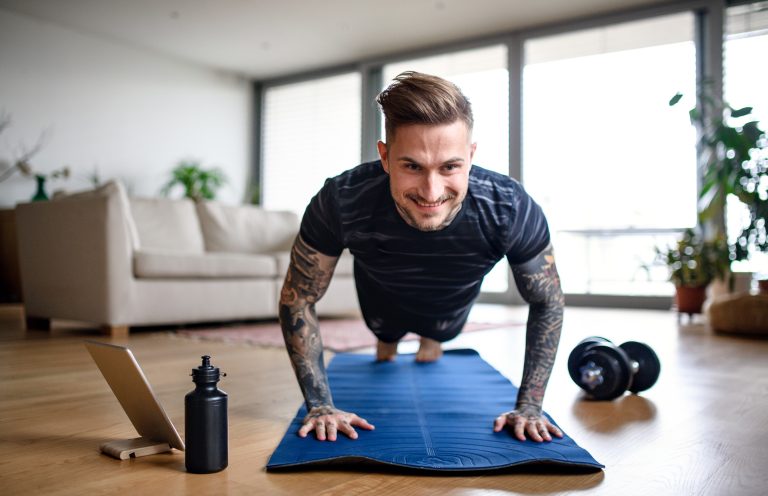
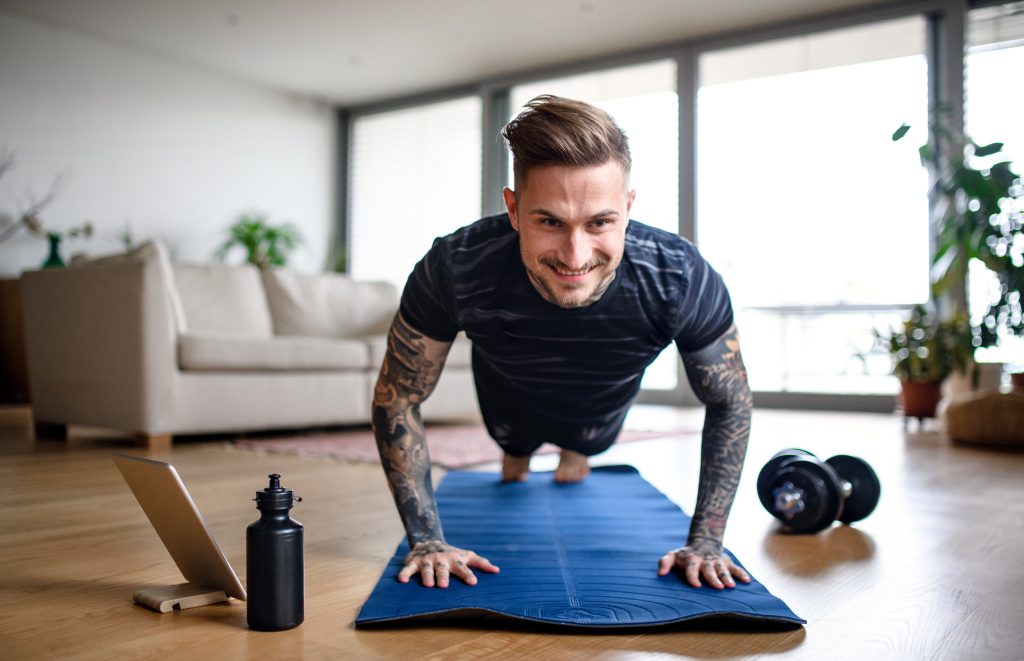
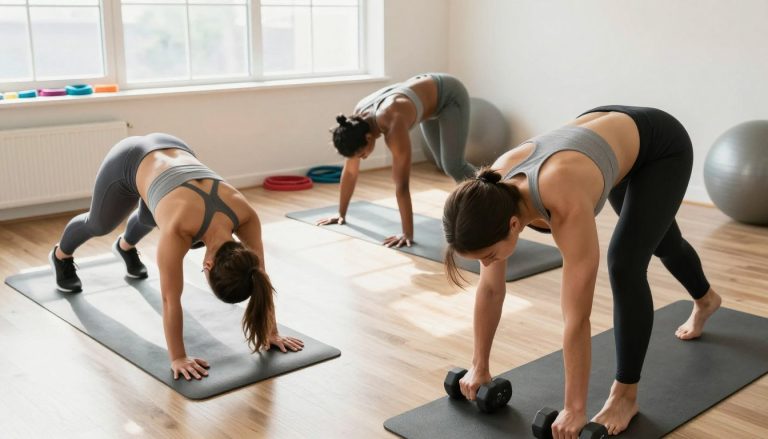
Push-Up Start in a high plank — hands just wider than shoulder-width, body in one straight line from head to heels. Lower your chest to the floor by bending your elbows at a 45-degree angle from your torso (not flared straight out). Push back up. Beginners: Do this on your knees until you can complete 10 full push-ups with good form. Muscles: Chest, shoulders, triceps, core
Pike Push-Up Start in a downward dog position — hips high, forming an inverted V. Bend your elbows to lower the crown of your head toward the floor. Push back up. Muscles: Shoulders, triceps, upper back
Tricep Dip (Chair or Floor) Sit on the edge of a sturdy chair with your hands beside your hips. Slide forward, lowering yourself by bending your elbows to about 90 degrees. Push back up. If no chair: sit on the floor, place your hands behind you, and do the same motion. Muscles: Triceps, shoulders, chest
🟢 Core
Plank Forearms on the floor, body in a straight line from head to heels. Squeeze your core, glutes, and quads simultaneously. Don’t let your hips sag or rise. Muscles: Deep core, shoulders, glutes
Dead Bug Lie on your back, arms pointed at the ceiling, knees bent at 90 degrees. Slowly lower your right arm and left leg toward the floor — keeping your lower back pressed flat. Return and repeat on the other side. Muscles: Deep core stabilizers, excellent for lower back health
Mountain Climber High plank position. Drive one knee toward your chest, then quickly switch legs in a running motion. Keep your hips level and core braced. Muscles: Core, hip flexors, shoulders, cardio conditioning
🟡 Cardio / Full Body
Jump Squat (omit if joint sensitivity is a concern — swap for regular squat) Perform a squat, then explode upward into a jump at the top. Land softly with bent knees and go straight into the next rep.
Burpee (Beginner Version) From standing, squat down and place your hands on the floor. Step one foot back at a time into a plank position. Step feet back in. Stand up. No jump required for the beginner version.
High Knees (Low-Impact Option: March in Place) Run in place, driving your knees up to hip height. Pump your arms in opposition. For low-impact: march instead of run
.
Your 4-Week Home Workout Plan
This plan follows a full-body, 3-days-per-week structure — the format most strongly supported by research for beginners. Research shows beginners benefit most from full-body routines with adequate recovery, aiming for 2–3 sets of each exercise, stopping 2–3 reps short of failure to maintain good form.
Training Days: Monday / Wednesday / Friday (or any 3 non-consecutive days) Rest Days: Active rest — walk, stretch, or rest fully
📅 Week 1 — Build the Foundation
Focus: Learn the movements. Prioritize form over speed.
Warm-Up (5 min) — See warm-up section below
| Exercise | Sets | Reps / Time | Rest |
| Bodyweight Squat | 2 | 10 reps | 45 sec |
| Push-Up (or Knee Push-Up) | 2 | 8 reps | 45 sec |
| Glute Bridge | 2 | 12 reps | 45 sec |
| Plank | 2 | 20 seconds | 45 sec |
| Dead Bug | 2 | 6 reps each side | 45 sec |
| March in Place | 2 | 30 seconds | 30 sec |
Cool-Down (5 min) — See cool-down section below
Total workout time: ~20 minutes
📅 Week 2 — Add Volume
Focus: More reps, same movements. Your body should start feeling familiar with the pattern.
Warm-Up (5 min)
| Exercise | Sets | Reps / Time | Rest |
| Bodyweight Squat | 3 | 12 reps | 40 sec |
| Push-Up | 3 | 10 reps | 40 sec |
| Reverse Lunge | 2 | 8 reps each leg | 40 sec |
| Glute Bridge | 3 | 15 reps | 40 sec |
| Plank | 3 | 25 seconds | 40 sec |
| Mountain Climber | 2 | 30 seconds | 30 sec |
Total workout time: ~25 minutes
📅 Week 3 — Increase Intensity
Focus: Introduce harder variations and reduce rest time.
Warm-Up (5 min)
| Exercise | Sets | Reps / Time | Rest |
| Jump Squat (or Squat) | 3 | 12 reps | 35 sec |
| Push-Up | 3 | 12 reps | 35 sec |
| Pike Push-Up | 2 | 8 reps | 35 sec |
| Reverse Lunge | 3 | 10 reps each leg | 35 sec |
| Plank | 3 | 35 seconds | 35 sec |
| Burpee (Beginner Version) | 2 | 8 reps | 45 sec |
| Dead Bug | 2 | 8 reps each side | 35 sec |
Total workout time: ~28 minutes
📅 Week 4 — Full Circuit
Focus: Combine movements into a flowing circuit. This trains strength and cardio simultaneously.
Warm-Up (5 min)
Circuit A — Complete 3 rounds, 30 sec rest between rounds:
- Jump Squat × 12
- Push-Up × 12
- Reverse Lunge × 10 each leg
- Mountain Climber × 40 seconds
Rest 90 seconds
Circuit B — Complete 3 rounds, 30 sec rest between rounds:
- Pike Push-Up × 8
- Glute Bridge × 15
- Plank × 40 seconds
- Burpee (Beginner) × 8
Cool-Down (5 min)
Total workout time: ~30–35 minutes
Progress check after Week 4: Can you do 15 full push-ups? 3 sets of 15 squats? A 45-second plank? If yes — you’re ready to level up. See the progression section below.
How to Warm Up and Cool Down
Never skip these. A 5-minute warm-up reduces injury risk and gets blood flowing to your muscles before they’re asked to work hard.
Warm-Up (5 minutes)
Perform each for 30–45 seconds:
- Arm circles — forward and backward
- Leg swings — front-to-back, then side-to-side
- Hip circles — hands on hips, slow rotations
- Inchworm — hinge at hips, walk hands out to plank, walk back, stand
- Jumping jacks or marching in place — raise your heart rate gently
Cool-Down (5 minutes)
Hold each stretch for 20–30 seconds per side:
- Standing quad stretch — hold ankle to glute
- Figure-four stretch — seated or standing, cross ankle over knee
- Child’s pose — kneel and reach arms forward on the floor
- Cat-cow — on hands and knees, arch and round your spine slowly
- Standing chest opener — clasp hands behind back, open chest toward ceiling
How to Keep Progressing After Week 4 {#progression}
The biggest mistake people make after a beginner plan? Doing the same thing forever and wondering why results stall.
Small improvements build momentum, and the key principle that unlocks long-term results is progressive overload — gradually making your workouts slightly harder over time.
Here’s how to apply it without any equipment:
- Add reps: If you could do 12 squats comfortably, aim for 15
- Add sets: Move from 3 sets to 4
- Reduce rest: Cut rest periods from 45 seconds to 30 seconds
- Slow down the tempo: A 3-second lowering phase on push-ups dramatically increases difficulty
- Progress the movement: Knee push-up → Full push-up → Diamond push-up → Archer push-up
- Add a weekly workout: Move from 3 days/week to 4
Common Mistakes to Avoid
1. Skipping the warm-up. Cold muscles are more prone to strain. Five minutes is all it takes. Never skip it.
2. Prioritizing speed over form. A sloppy push-up doesn’t build your chest — it builds poor movement patterns and injury risk. Slow down and feel the muscle working.
3. Doing the same workout every day. Your muscles grow during rest, not during the workout itself. Three focused sessions per week with recovery days is more effective than daily training with no structure.
4. Not tracking progress. If you don’t write down your reps and times, you have no way of knowing if you’re progressing. Use your phone’s notes app or a simple notebook.
5. Quitting too early. New research reveals that strength training for 90 minutes a week was linked with almost four years less biological aging. That’s three 30-minute sessions. Commit to four weeks before judging results. The first two weeks are foundation-laying — the visible changes come later.
Frequently Asked Questions
Can you really build muscle with bodyweight exercises? Yes. Muscle growth requires mechanical tension and progressive overload — both of which are achievable with bodyweight training. The key is continuing to make the exercises harder over time, using the progression methods outlined above.
How many days a week should I work out at home? Three days per week is the evidence-based sweet spot for beginners. This gives your muscles sufficient stimulus to grow while allowing adequate recovery between sessions. As you advance, 4 days per week is appropriate.
How long before I see results from a home workout plan? Most people notice improved energy and strength within 2–3 weeks. Visible body composition changes typically emerge at 4–8 weeks of consistent training, combined with appropriate nutrition.
What if an exercise is too hard for me? Modify it. Every exercise in this plan has an easier version listed. Knee push-ups instead of full push-ups, marching instead of high knees, regular squats instead of jump squats. Starting modified and progressing is exactly how it’s supposed to work.
Do I need to eat differently when working out at home? Nutrition amplifies your results significantly. For general fitness, prioritize protein at each meal (eggs, chicken, legumes, dairy), stay hydrated, and limit ultra-processed foods. You don’t need a strict diet — just consistent, balanced eating.
Is this plan suitable for people over 50? Absolutely. Modify high-impact moves (swap jump squats for regular squats, burpees for step-back lunges) and focus on controlled form. The glute bridge and dead bug are particularly valuable for older adults because they protect the lower back and improve functional movement.
What if I miss a day? Just pick back up where you left off. Missing one session doesn’t derail progress — missing a week does. Consistency over time matters far more than perfection in any given week.
The Bottom Line
You don’t need a gym membership, expensive gear, or even a lot of time. You need a plan, consistency, and a willingness to start.
This 4-week program gives you a structured, progressive path from total beginner to someone who moves with genuine strength and confidence. The hardest part is the first workout. After that, momentum builds.